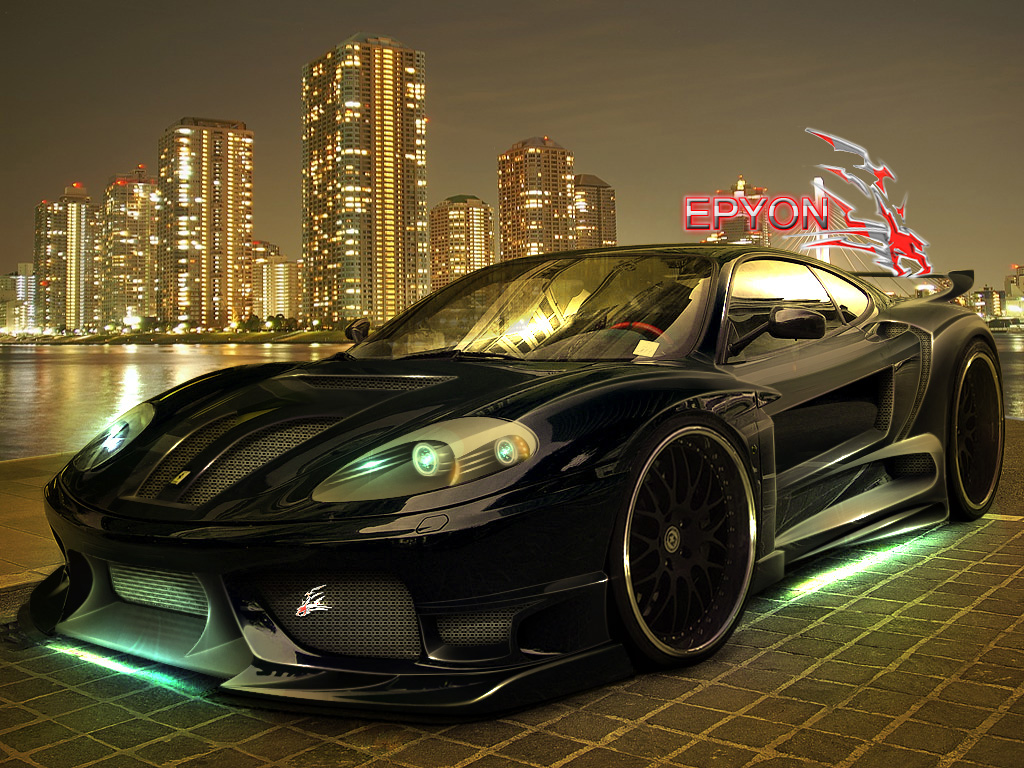
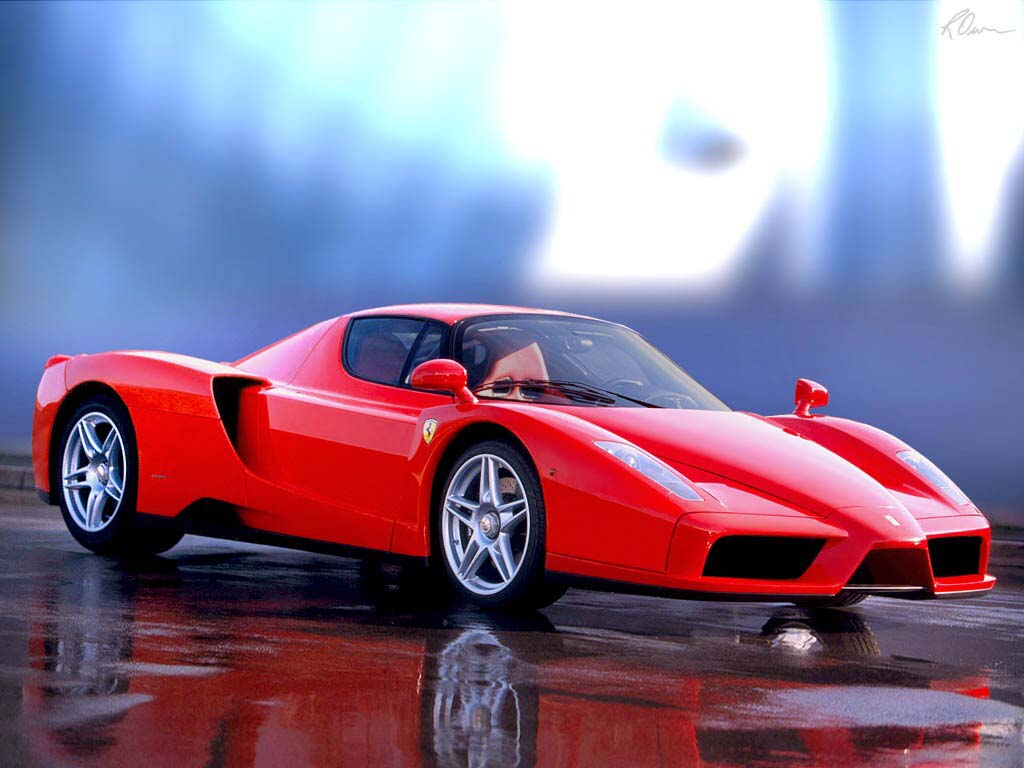
Black Ferrari F430
 Black Ferrari F430
 Black Ferrari F430
 Black Ferrari F430
 Ferrari 458 Italia Rear
 Ferrari 458 Italia Rear
 Ferrari 458 Italia Rear
 Ferrari 458 Italia Rear
 Ferrari 458 Italia Rear

California is where trends start and the new Ferrari California offers
some new trends. It’s Ferrari’s first front engine V8, the first with direct
fuel injection, the first with a seven-speed transmission, the first with real
launch control, the first with a retractable hardtop, and the first with a
stacked exhaust. Regardless of these new additions, the California has
the goods - a real Ferrari it is indeed! See the Slideshow of this excellent
GT below.
Past Ferraris have had front engine V6s and V12s but with its 4.3-liter
8-cylinder, Ferrari has made this entry level a great sports car. It shares the
same engine with the F430, however, it is heavier than the F430. Therefore,
the horsepower was dropped a bit to 457 hp but torque was upped to 357 ft- lbs.
The Getrag dual-clutch seven speed gearbox is marvelous in that it provides
continuous acceleration and it allows a great sounding power note between
shifts.
So what will the California do with its seven-speed transmission and
a heavy breathing Ferrari engine? It does 0-60 in 3.5 seconds and the
quarter mile in 11.9 second at 117.4 mph. The top speed is 193 mph.
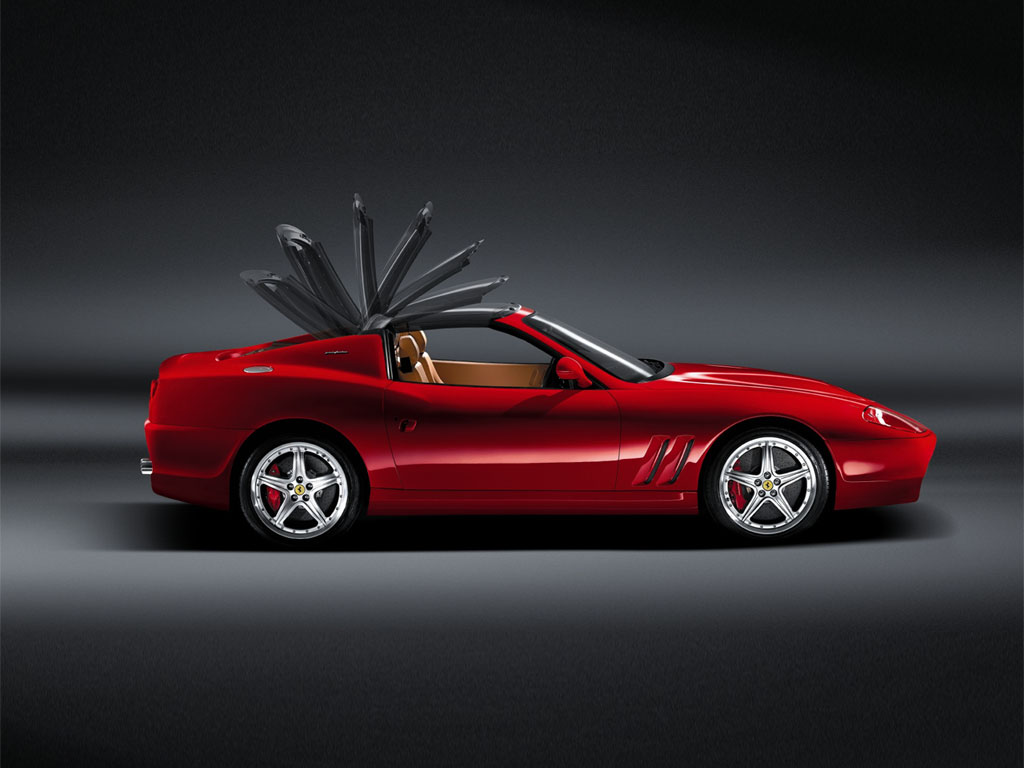
Ferrari chose not to go with a ragtop but rather a retractable hardtop.
Even with the top down, the body structure is rigid as is Ferrari customary.
Another feature about the top is that it will not raise or lower if something
like a garage door opening does not provide the necessary clearance.
The California is equipped with ceramic brakes, however, Ferrari has
adjusted the brake system so that the brakes are not overly aggressive
and annoying for road driving. The brakes are compliant and easy to
use and provide stops from 60 mph in only 100 feet.
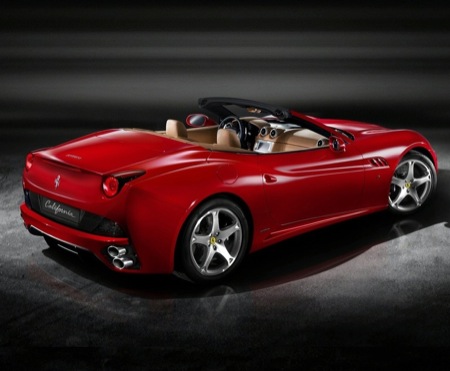
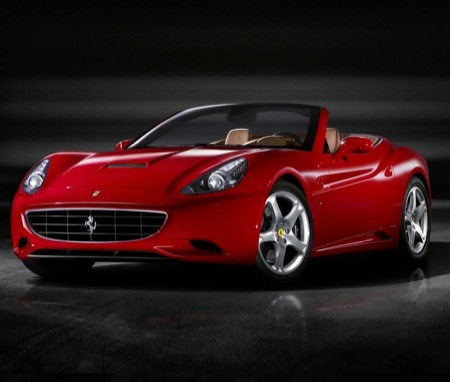

The California is a bit like my first girlfriend: pretty from the front, but a little frumpy at the rear, especially in the wrong clothes (sorry Sarah). This is Ferrari’s softer side. Huh? How can you mess with the classic GT recipe? Sorry Ferrari but the California is the best definition of Ugly Betty with four wheels. If you were hoping for a Dino successor, then you’ll be disappointed. This is a fresh GT with a new clientele in mind.
Hoping for a warm welcome party, my blue press car just didn’t look right under the brilliant Sicilian sunshine– even though I skipped the offer of a blood-red California, which I thought would dispel the miss-matched lines and kindergarten crayon-like sketches. Like the 612 Scaglietti, the latest front-engined Ferrari has no Maranello designer-DNA-flair whatsoever. Sure, the front is OK, but the rear looks like a F430 that’s been backed into a brick wall. And then we have the Lexus cosmetic card trick: fake exhaust tail pipes. The horrendous back door abomination was designed to incorporate the folding metal roof. With every supercar manufacturer fitting an origami roof to just about anything that moves, the boys in Italy wanted to target more conservative customers (namely female, but you didn’t hear me say that).

The buggy seats behind the front chairs are useless for any human larger than Verne Troyer. And? They are perfectly suitable for those owners who wish to fold them to accommodate your tailored Ferrari luggage or McLaren golf bags. While it’s all very Ferrari inside, there are two small issues that need addressing. First, the heater control pane is ridiculously small. I know owners live in salubrious climates, but really. Second, the aluminium covered centre console looks like a particularly uncomfortable sex toy. The sexy, red Start button and Manettino switch (Ferrari’s traction and stability control), return us to the world of more traditional sexual orientation. Both controls must tweaked and caressed like a lover’s nipple to get the desired effect. Ahem. Moving on…

Facing killjoy CO2 regs, Ferrari had to clean up their act. To satisfy the politicians, Maranello has introduced direct-injection technology to their famous V8. Although positioned over the front axle, the new 4.3-litre flat-plane-crank V8 knocks-out 454bhp and 357 lb feet of gut-busting torque. The Calfornia drop top nails the zero to 62mph sprint in around four seconds and cracks 194mph V-max. Not bad for a car that’s carrying 1735 kg’s.
Whether you’re nailing your favourite back road or performing a brief overtaking manoeuvre whilst kicking back on the boulevard, the California V8 delivers the same sorts of aural delights enjoyed by F430 drivers. Ferrari’s dialed down the bass and treble, but with the roof stowed, hunting the red-line is equally tempting. The new seven speed twin-clutch transmission swaps gears quicker than the F430 Scuderia, which is like saying an F-22 is a bit quicker than an F-15. Porsche’s PDK may have set the benchmark, but they forgot about Ferrari’s F1 technology. This is Transformers for grown-ups.

The Manettino switch on the steering wheel offers a choice of Comfort, Sport or CST-off mode. Comfort is the default choice with relatively low intervention thresholds; the Sport setting raises the bar and allows for a good degree of tail swapping and tire mashing. The CST mode turns off all of the driving aids and reveals the California’s hidden side: beautiful balance on the limit behaviour.
This is where the buttons ping off your shirt and you start to turn green. The combination of engine, handling and hidden Ferrari DNA bursts out more alarmingly than the alien in John Hurt’s chest. The steering is quick but grip levels are less communicative through the steering wheel. Where the California really shines: its ride. With the optional $6k magnetic dampers, the Fezza delivers sensational body control and accuracy, without destroying ride comfort.

So, where does the new California fit within the Ferrari canon/cannon? At a not inconsiderable $244k, it’s got to fend off a raft of competition, including Lamborghini’s cheaper Gallardo Spyder ($224K). Why have Ugly Betty when you can choose Beyonce Knowles? Because it’s a Ferrari. A Ferrari convertible. And even though it’s a kindler gentler example of the breed, that’s enough.
[Ferrari provided the vehicle, insurance, and fuel]

The new Ferrari 458 Italia has supermodel looks, but what’s it like to drive?
The Ferrari 458 Italia is the car tuned by seven-time Formula One champion Michael Schumacher.
The German, regarded by some as the greatest driver of all time, spent roughly 40 hours behind the wheel of the new Ferrari 458 Italia, feeding his unique insights to the engineers based on his considerable experience in car set-up.
That’s no guarantee of success for the latest supercar to wear the legendary Prancing Horse badge, but it’s not a bad start.
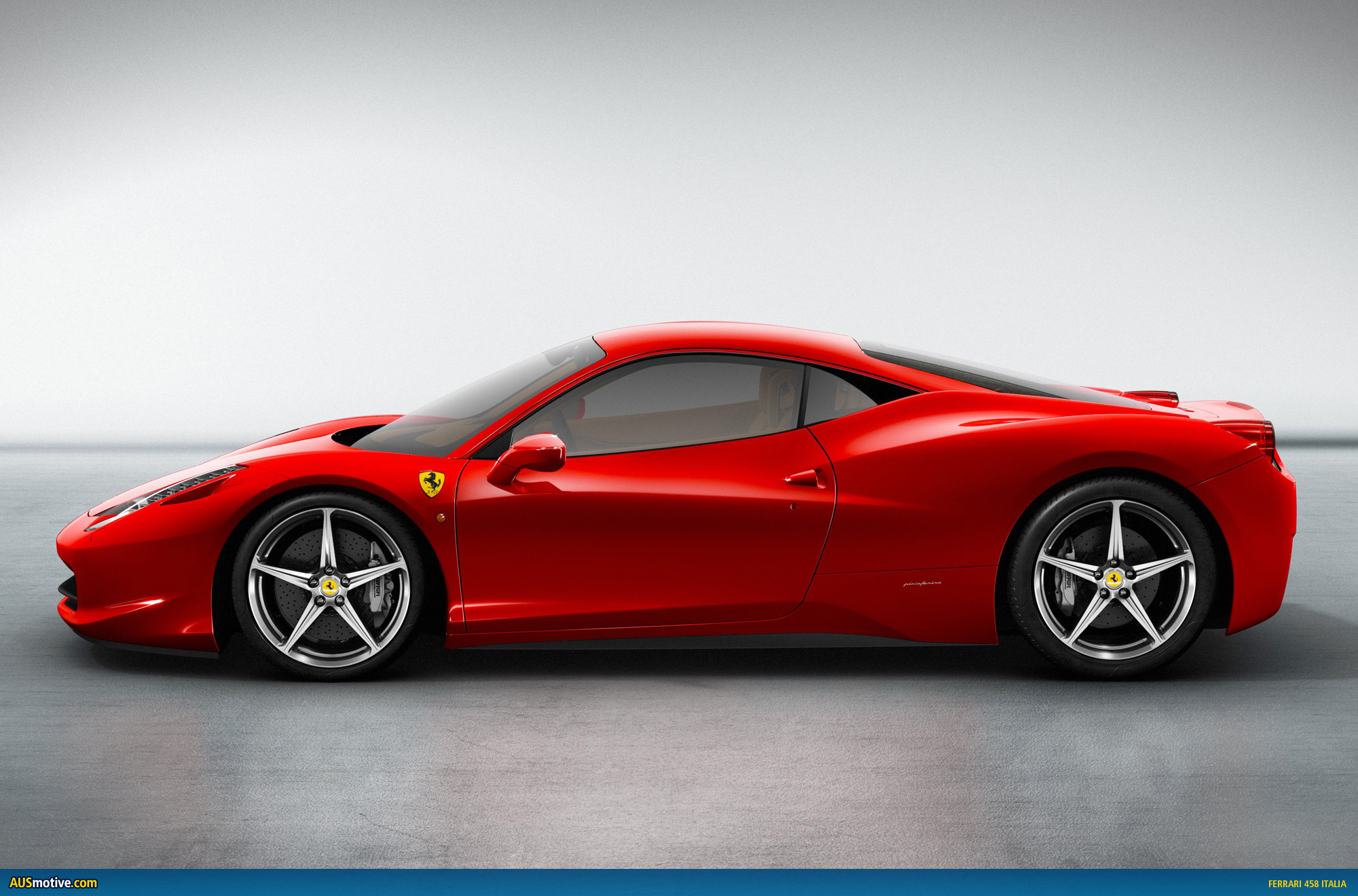
Neither is the first impression you get when you see the 458 in the flesh. It looks sensational – more stealth fighter than road car. It’s a cleaner design than the F430. 
The big air intakes that dominated the flanks of the F430 have been replaced by more discreet vents on the car’s window sills and under the rear wings.
The vertical daytime running lights add another dash of theatre, while the cluster of three exhaust pipes at the rear looks like a jet’s afterburner. 
Step inside and the Ferrari 458 Italia is equally impressive. Other manufacturers like to talk about a driver-oriented, cockpit-feel, but this car delivers. In fact, the passenger is almost cut out of the picture altogether.
There is no conventional centre stack. Instead, there are two screens either side of the giant tacho in the instrument panel. The one on the left has the read-out for the vehicle set-up and (too small) digital speedo, while the one on the right has the sat-nav and audio (there’s no CD player, instead you get a red Ferrari iPod and docking station). 
The only buttons within easy reach of the passenger are the air-con controls and the three buttons on the centre console – the launch control, reverse gear selector and auto transmission setting. 
In contrast, almost every system in the car is at the fingertips of the driver. There are no indicator stalks, the blinkers are activated by buttons on the steering wheel, as are the headlights and windscreen wipers. It seems a little odd at first, but works well. The driver can also select a softer suspension setting via another button on the wheel, while the trademark “Manettino” switch allows you to choose from five different set-ups.
The rest of the cabin is traditional leather-lined luxury, including supportive racing seats, with great side and thigh support.
Start the Ferrari 458 Italia up, blip the throttle and the intoxicating sound of a thoroughbred V8 fills the cabin.
The Italia’s 425kW V8 sounds surprisingly tame and refined when you’re driving sedately around town. But as with most sports cars these days, the Ferrari has an exhaust bypass flap that opens up as the revs rise. The harder you push the 458, the better it sounds, all the way to an ear-splitting 9000rpm.
But the noise is only a small part of the fun. The acceleration is mind-boggling. Ferrari says the 458 reaches 100km/h in 3.4secs and 200km/h in 10.4secs. After a day driving the car on the track and the open road, we found no reason to doubt those figures.
Some of the credit for the blistering acceleration goes to the Ferrari’s seven-speed dual clutch automatic transmission. The maker decided not to develop a manual transmission for the 458 because it says the dual-clutch delivers noticeably better performance while using less fuel.
The shifts in the Ferrari 458 Italia are razor-sharp and intuitive, with the car downshifting automatically each time you hit the awesome ceramic brakes. Each downshift is accompanied by a wonderful-sounding blip of the throttle, whether you change gears by the paddleshifts or let the 458 do it for you. The car also gargles and spits when you come off the throttle.
A flick of the Manettino really transforms the car from luxury grand tourer to race-car. The Manettino adjusts the car’s suspension, throttle sensitivity, gear shift patterns, brake feel and suspension settings. It also adjusts the sensitivity of the various driver aids, including the traction control, stability control and electronic diff, which distributes torque between the rear wheels to increase drive out of corners.
The suspension and steering are the final pieces in the jigsaw and neither disappoints. As always, we’ll reserve judgment on the ride until we get the car on local roads, but it was impressively well-controlled and comfortable on patchy road surfaces. The strangely named “bumpy road” setting also works well. It’s only available on the sportier settings and it’s designed to improve the tyres contact with the road on rough surfaces.
The setting softens the dampers so the car is less prone to skip about over corrugations.
The Ferrari 458 Italia’s grip was phenomenal, even when driven enthusiastically on wet roads, while body roll was hardly noticeable through corners. The car’s exceptional handling encourages you to push harder at each corner, while the steering is incredibly sharp and direct, adding to the overall feeling of supreme surefootedness.
It may be hideously expensive and unashamedly politically incorrect, but the Ferrari 458 Italia is one truly impressive machine.
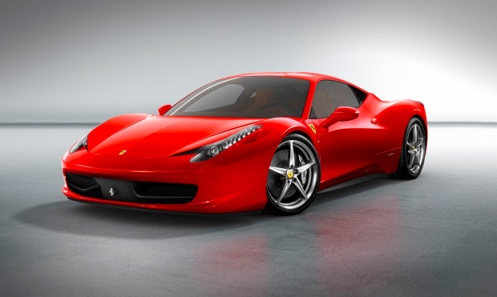
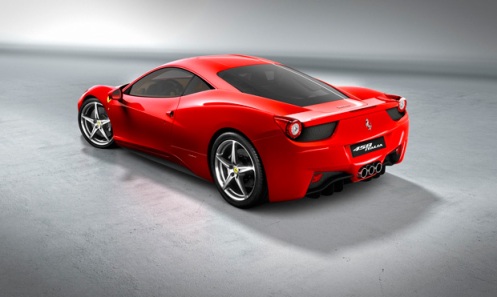
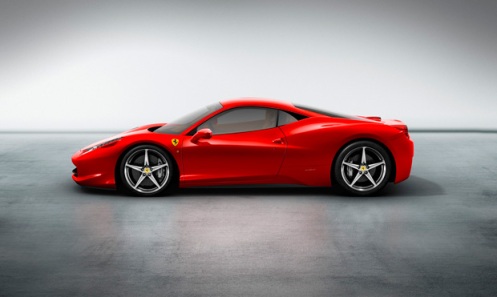
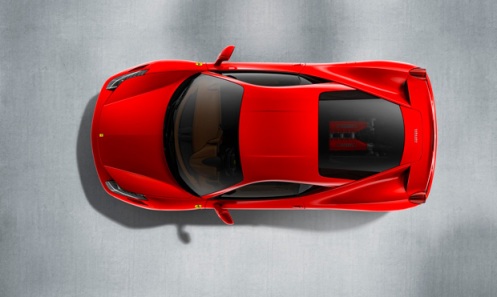
A 570bhp mid-engined sports car from Ferrari would have been enough to satisfy most but the 458 Italia happens to be gorgeous as well.
There are lots of highly desirable destinations for a car budget of over £150,000 but with this package of engineering and design, Ferrari has assembled a compelling case for sending it to Maranello.
Like any car manufacturer, Ferrari has had its ups and downs over the years. There are models which are revered as classics and those which are routinely shunned but in recent times, it’s been on something of a roll. Enzo, F430, 612, 599, even the California was warmly received by those who appreciated the need for it. It looked like the brand could do no wrong but was it building towards crescendo or catastrophe? The answer came as the covers fell from the 458 Italia and applause surged in the air.
It’s interesting that the period which may soon be looked back on as one of Ferrari’s greatest took place at a time when supercar manufacturers were under increasing strain. Growing environmental concerns and, latterly, major financial upheaval are not the preferred back drops against which to retail high performance sportscars costing north of £150,000. In the build-up to the arrival of the 458, Ferrari must also have been feeling the squeeze from a number of rival products dropping into the top end of the sports car market. Lamborghini, Aston Martin and Mercedes-Benz were all flexing their muscles in the sector and McLaren had announced its MP4-12C follow-up to the mighty F1. Looking at these factors and then at the 458 Italia, the only reasonable conclusion is that Ferrari thrives under pressure.
Mounted at the heart of the 458 is a phenomenal V8 engine. Based on the same block as the unit in this car’s F430 predecessor, it’s boosted to a 4.5-litre capacity and revs to a spine-tingling 9,000rpm. The maximum power output of 570bhp is achieved on that rev limiter and it’s enough to transport the 458 through the 0-62mph sprint in 3.4s. Guaranteeing the car’s supercar status are the facts that it will pass 124mph in 10.4s and reach a top speed on the scary side of 200mph.
Power is sent from the mid-mounted engine to the rear wheels via Ferrari’s double-clutch gearbox marshalled by wheel-mounted paddle shifters – there’s no manual option. Helping to get it all onto the road efficiently is the highly advanced e-diff electronic differential and the F1-Trac traction control system found in the 599. The braking system uses carbon ceramic discs gripped by 6-pot aluminium callipers on the front and four-pot items on the rear. It’s enough to get the 458 from 62mph to a standstill in a little over 32 meters.
"Mounted at the heart of the 458 is a phenomenal V8 engine?."
It’s a sad reality that most people will never drive a Ferrari 458 Italia and will have to make do with marvelling at it on magazine covers and motorshow stands. It’s a beautiful car, so there are worse ways to while away some time but there’s also function in its exquisite form. Stylists Pininfarina sculpted the bodywork around the various cooling and aerodynamic constraints laid down by the engineers.
The rubber wings inside the frontal air-intake are designed to deform at high speed, closing off the radiator for improved aerodynamics. At lower speeds when more cooling is needed, they allow the air in and it exits through the wing vents at the side of the avant-garde front light clusters. The gearbox and clutch are cooled by the intakes on the elegantly elongated tail, with the air exiting through its mesh sections. Signature styling features include the windscreen that plunges down below the bonnet line and the trio of exhaust pipes flanked by the super aggressive rear splitter. In total, the 458 bodywork produces 140kg of downforce at 124mph with a drag coefficient of just 0.33Cd.
The interior is pared down and intensely focused on the business of driving. Steering column stalks have been eliminated, with the controls placed on the steering wheel itself along with the engine start button and the settings for the stability control system. There’s a definite Formula One feel to the wheel as a result, but owners won’t be able to take it off and carry it around with them.
The market for sportscars costing over £150,000 isn’t particularly vibrant at the moment but the 458 Italia should have the requisite wow factor to compete with the best of the rest. The Ferrari name still carries enormous weight and there will be little chance of its profile waning while it can churn out products like this. McLaren, Mercedes-Benz, Aston Martin, Porsche and Lamborghini all have vehicles that could be deemed alternatives to the 458 and that’s a buying decision that any petrolhead would give their eye teeth to be able to make.
Options for the 458 are more numerous than you might think. Buyers can specify diamond finish forged alloy wheels or super lightweight carbon fibre seats. Then there are numerous accessories and features arranged under the headings ‘Racing and Track’, ‘Exterior and Colours’, ‘Interior and Materials’ and ‘Equipment and Travel’. Where there’s most scope for personalisation is in the almost infinite number of possible trim combinations for the interior. Your Ferrari dealer will wheel out a vast catalogue of different material and colour choices to adorn the car’s cabin.
Astronomical probably won’t do the 458 Italia’s running costs justice but little issues like servicing, parts, fuel and insurance will be an irrelevance to the majority of this car’s owners. These days, even Ferrari must make some kind of offering at the alter of the environment and the 570bhp V8 does have variable valve timing, high pressure phased fuel injection and innumerable weight saving measures which help efficiency. There’s no use pretending their primary focus isn’t to help make the 458 go like stink though. For the record, official combined economy is 13.3mpg and CO2 emissions are 307g/km
Ferrari’s enviable recent record of producing mind-blowing sportscars looks to be in safe hands with the 458 Italia. The stunning bodywork isn’t merely an exercise in automotive art, it’s sculpted around the machine’s need for downforce, cooling, balance and grip. The intensely driver-focused cabin with its F1-esque steering wheel hints at the car’s potential but it’s when that needle hits 9,000rpm and the V8 is giving up its 570bhp in full that the 458 will reveal what it’s truly made of.
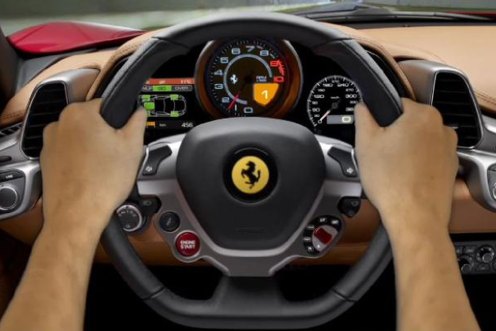


 2010 Ferrari 458 Italia
 |
 |
 |
 |
 |
 |
 |
 |
 |
 |
 |
 |
 |
 |
 |
 |